Folklore · China · Legend
Chang'e (嫦娥)
Also known as: Chang'e, 嫦娥, Heng'e, 姮娥, Chang-o, Moon goddess, Chang'e flies to the moon, 嫦娥奔月
In short
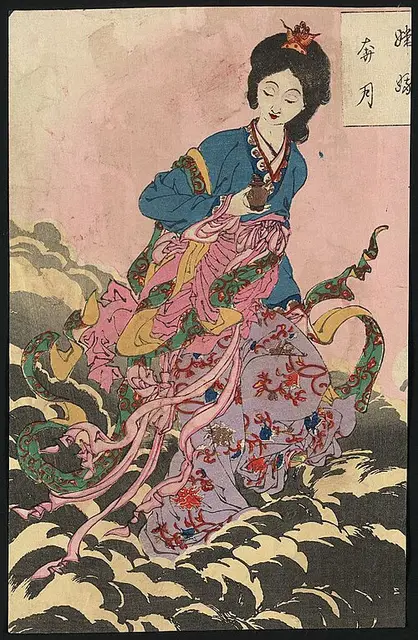
Chang'e is the woman in Chinese myth who swallowed the elixir of immortality and flew to the moon, where she still lives. In most versions she is the wife of the archer Hou Yi, who received the elixir from the Queen Mother of the West. She is the figure most closely linked to the moon and to the Mid-Autumn Festival.
At a glance
| Where | China, and wherever the Mid-Autumn Festival is kept |
|---|---|
| Earliest record | Huainanzi, chapter Lanming, about 139 BC. Older fragments of the Guicang, a divination book, tell the same flight |
| Original name | Heng'e (姮娥), changed to Chang'e to avoid the personal name of Emperor Wen of Han, Liu Heng |
| Husband | Yi or Hou Yi, the archer who shot down nine of ten suns in later versions |
| Companions on the moon | The Jade Rabbit, which pounds the elixir. In some versions also Wu Gang |
The best-known story Contains the ending
Ten suns rose in the sky together and scorched the earth. The archer Hou Yi shot down nine of them. As a reward he received the elixir of immortality from the Queen Mother of the West, in two portions.
Accounts differ on why Chang'e took it. In the older texts she simply steals it from her husband and flees so that he cannot follow. In the version most often told today, Hou Yi's apprentice Fengmeng tries to seize the elixir while Hou Yi is away. To keep it from him, Chang'e swallows all of it herself. Her body grows light and she rises until she reaches the moon.
On the moon she lives with the Jade Rabbit. Hou Yi stays behind on earth.
The oldest texts
The Huainanzi, compiled at the court of Liu An and presented around 139 BC, mentions the story in one sentence in the chapter Lanming: Yi asked the Queen Mother of the West for the drug of no death, and Heng'e stole it and fled to the moon. Yi is left distraught and cannot get more, because he does not know where the drug comes from.
The story is older than this. Later books quote a lost divination text, the Guicang, on Heng'e fleeing to the moon. In 1993 bamboo slips of the Guicang were found in a Qin tomb at Wangjiatai, Jingzhou, Hubei. One slip reads that Heng'e (written 恒我) stole the drug of no death. In these fragments Yi does not appear. Some scholars read this as a sign that the flight to the moon was first a story of its own and was joined to Yi later.
In Zhang Heng's Lingxian (2nd century) and in the Soushen ji (4th century), Chang'e first asks a diviner named Youhuang, who tells her the journey west will end well. Once on the moon she becomes a toad.
Changes over time
- From toad to beauty. Han writers say she turned into a toad on the moon. Later poets and painters show her as a beautiful woman in a moon palace.
- From theft to sacrifice. In the Huainanzi she steals the elixir. The modern version with Fengmeng makes her take it to protect it.
- The Jade Rabbit. Early Chinese poetry already speaks of a hare in the moon that pounds herbs. Later it becomes her companion pounding the elixir.
- Wu Gang, the man who cuts the cassia tree on the moon, comes from a separate legend. Some versions make him one of her companions.
Chang'e and the Mid-Autumn Festival
The Mid-Autumn Festival falls on the 15th day of the 8th lunar month, at the full moon. It became a popular festival in the Tang dynasty, and mooncakes became part of it in the Song. Chang'e is the festival's best-known figure. Families set out offerings to the moon, and the Chang'e story is often told as the festival's origin. Girls traditionally prayed to her for help in love. Some families also put a clay figure of the Jade Rabbit on the festival table and make offerings to it.
In modern culture, China's lunar exploration programme is named after her. Chang'e 1 launched in 2007, and the programme's lunar rovers are named Yutu, Jade Rabbit.
Similar legends elsewhere
Same story: the plot is close. Same kind of figure: a similar being in a different story.
- Same kind of figure · JapanKaguya-himeA woman from the moon who goes back there. She leaves an elixir of immortality, which the emperor has burned on a mountain
- Same kind of figure · East Asia, EuropeSwan maiden talesA wife who leaves her husband and rises into the sky
- Same kind of figure · IndiaThe hare in the moon (Jataka 316)A Buddhist tale in which a hare offers itself as food and Śakra draws its likeness on the moon
- Same kind of figure · Japan, KoreaThe moon rabbit in Japan and KoreaThe same hare in the moon, but pounding rice cakes (mochi or tteok) instead of an elixir
FAQ
Why did Chang'e fly to the moon?
She swallowed the elixir of immortality that Hou Yi had received from the Queen Mother of the West. In the older texts she steals it. In the version most told today she swallows it to keep it from Hou Yi's apprentice Fengmeng.
Is Chang'e a goddess?
She is called the moon goddess and receives offerings at the Mid-Autumn Festival. In the early texts she is a woman who becomes immortal by taking the elixir.
Who is the rabbit with Chang'e?
The Jade Rabbit, a hare that lives on the moon and pounds the elixir of immortality with a pestle. The hare in the moon is older than the link with Chang'e.
Did Chang'e turn into a toad?
In Zhang Heng's Lingxian and the Soushen ji, yes. After reaching the moon she becomes a toad. Later versions dropped this and show her as a beautiful woman.
Sources
- 淮南子 覽冥訓 (Huainanzi, Lanming), Liu An and his court scholars, c. 139 BC
- 王家台秦簡 歸藏 (Wangjiatai Qin bamboo slips, Guicang), excavated 1993, Jingzhou, Hubei
- 靈憲 (Lingxian), as quoted in later works, Zhang Heng, 2nd century
- 搜神記 卷十四 (Soushen ji, ch. 14), Gan Bao, 4th century
- 嫦娥, Chinese Wikipedia
- Chang'e, English Wikipedia
- 嫦娥是如何奔月的, Guangming Online (光明网), 2022
- Mid-Autumn Festival, English Wikipedia
- Moon rabbit, English Wikipedia
Folktales have many versions. This page follows the best-known version and the earliest written records. Sources checked .