Folklore · Southeast Asia · Folktale
Malin Kundang
Also known as: Malin Kundang Anak Durhaka, Malim Kundang, Batu Malin Kundang, Legenda Malin Kundang, Si Tanggang, Nakhoda Manis
In short
Malin Kundang is a folktale of the Minangkabau people of West Sumatra, Indonesia. A poor boy leaves his mother to seek his fortune at sea, returns rich and married, and refuses to admit she is his mother. Indonesian children learn it as the story of the anak durhaka, the son who wrongs his parent.
At a glance
| Where | West Sumatra, Indonesia; the story is set at Air Manis beach, south of Padang |
|---|---|
| People | Minangkabau; told as a kaba (traditional Minangkabau story) |
| Earliest record | Oral tradition; a closely related Selangor version was printed in W. W. Skeat's Malay Magic (1900) |
| Type | Moral tale; legend explaining a rock |
| Related tales | Si Tanggang (Malaysia), Nakhoda Manis (Brunei) |
The story Contains the ending
Malin Kundang is the only child of a poor widow in a fishing village on the coast near Padang. When he is young he begs to go to sea on a merchant's ship. His mother does not want him to go, but she lets him leave and asks him to come back.
Years pass with no news. In the Indonesian telling, his ship is attacked by pirates and he survives by hiding, lands in another place and works until he becomes a rich merchant with ships of his own. He marries.
One day a fine ship anchors at his home village. His mother, now old and in ragged clothes, recognises her son and comes to greet him. Ashamed in front of his wife, Malin says this woman is not his mother. In some versions he pushes her away, and he sails off.
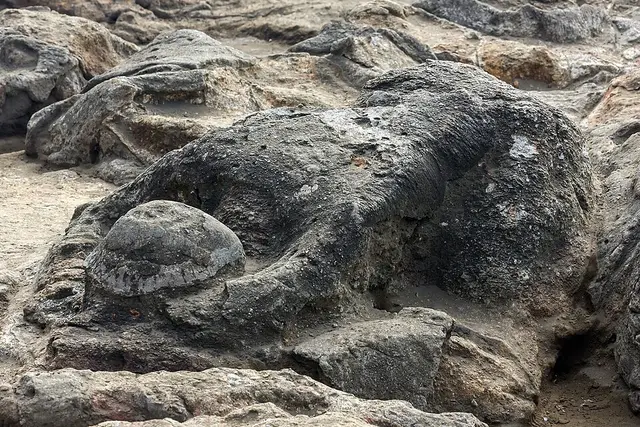
The mother prays. In a common Indonesian telling she says, 'O God, if he really is my son, I curse him to become a stone.' A storm breaks the ship. Malin is thrown onto the beach of his birthplace, his body stiffens and he turns into rock, often described as kneeling and asking forgiveness too late.
The stone at Air Manis
Air Manis (Minangkabau: Aia Manih) is a beach about 10 km south of central Padang, behind Gunung Padang. On the sand lies a rock shaped like a man bowed face down, with nearby rocks shaped like a ship's timbers, a coil of rope and a barrel.
The figure is not a natural formation. It was made as a work of art in the 1980s by Dasril Bayras and Ibenzani Usman, and it made Air Manis one of Padang's best-known tourist spots. Waves and repairs have worn the figure over the years.
How other places tell it
- Malaysia: Si Tanggang. A poor boy sails away, marries a princess and denies his parents when they paddle out to his ship. His mother's curse turns him, his wife and crew to stone. Batu Caves in Selangor was once known as Kapal Tanggang, Tanggang's ship.
- Brunei: Nakhoda Manis. The son of the widow Dang Ambon grows rich in Sulu and pushes his mother's boat away on the Brunei River. The rock Jong Batu in the river, shaped like a sinking ship, is said to be his vessel.
- Selangor, 1900: Megat Sajobang. Skeat printed a version told at Ulu Klang. The son forbids his men to let his parents aboard; the mother says 'If thou art really my son, reared at my breast, mayest thou be changed into stone,' and the ship turns to stone and later becomes a hill.
What the story is about
The tale is taught as a lesson about respect for parents, and durhaka (being disobedient or ungrateful to a parent) is the word attached to Malin's name.
Recent readings in Indonesia also point to the mother's place in the story. She raises her son alone and is poor and powerless, yet her word is the one that judges him. Some see the son's shame as a picture of how wealth changes how people treat their family.
In modern culture
D. Djajakusuma directed the film Malin Kundang (Anak Durhaka) in 1971, from a script by Asrul Sani, with Rano Karno in the cast. SCTV aired a Malin Kundang sinetron in 2005 and 2006 that moved the story to modern times. Indonesia issued Malin Kundang stamps in 1998 as part of a folk tales series.
Similar legends elsewhere
Same story: the plot is close. Same kind of figure: a similar being in a different story.
- Same story · MalaysiaSi TanggangA son who denies his parents from his ship and is turned to stone
- Same story · BruneiNakhoda ManisThe same story told about the Jong Batu rock in the Brunei River
- Same kind of figure · West Java, IndonesiaSangkuriangAnother Indonesian legend that explains a landscape feature through a son and his mother
FAQ
Is the Malin Kundang stone real?
The rock at Air Manis beach is real, but it was made by people. Dasril Bayras and Ibenzani Usman created it in the 1980s to show the end of the story.
Where is Malin Kundang from?
From the Minangkabau of West Sumatra. The story is set at Air Manis beach, south of Padang.
Is Malin Kundang the same as Si Tanggang?
They are versions of the same tale. Si Tanggang is the Malaysian name and Nakhoda Manis the Bruneian one. Names, places and some details differ.
What is the moral of Malin Kundang?
Do not deny or wrong your parents, especially once you are rich. The tale is used in Indonesia to teach respect for one's mother.
Sources
- Malay Magic, Being an Introduction to the Folklore and Popular Religion of the Malay Peninsula (Charitra Megat Sajobang, pp. 54-55), Walter William Skeat, 1900
- Malin Kundang, Indonesian Wikipedia
- Malin Kundang, English Wikipedia
- Si Tanggang, Malay Wikipedia
- Jong Batu, English Wikipedia
- Pantai Air Manis, Indonesian Wikipedia
- Bukan karena Kutukan, Batu Malin Kundang 'Si Anak Durhaka' Ternyata Buatan Manusia, Okezone, 2022
- Malin Kundang (film), English Wikipedia
Folktales have many versions. This page follows the best-known version and the earliest written records. Sources checked .