Nostalgia · Snacks and drinks · Chinese childhood memory
What is latiao?
Also called: spicy strips, la tiao, spicy gluten, Weilong
In short
Latiao ("spicy strips") are chewy strips of extruded wheat-flour dough coated in chili oil, sugar and seasonings, classified in China as seasoned flour products. They are generally said to have been invented in 1998 in Pingjiang county, Hunan, when floods made soybeans expensive and local makers of a soy snack switched to flour. Sold for about half a yuan outside schools, latiao became a defining childhood snack, and today it is a large regulated industry and still hugely popular.
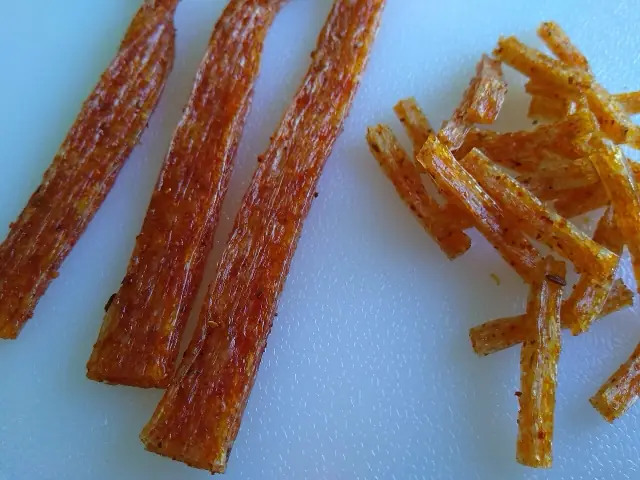
What it is
Imagine glossy red strips or flat sheets of chewy, gluten-like dough, slick with chili oil, sweet, salty and spicy all at once. They come in thin strips, wide slices and thick sticks, under many names; Tang Seng Rou ("Tang Monk meat") is one member of the family. Most are made from wheat flour, and versions made from soy are classed separately.
Timeline
| Year | What happened |
|---|---|
| 1998 | After floods push up soybean prices in Pingjiang, Hunan, local makers extrude flour into strips; accounts differ on who invented it |
| 1998–2001 | Pingjiang natives open factories elsewhere, including Luohe, Henan, where Weilong starts (founding year reported variously) |
| 2000s | Latiao becomes the classic "five-mao snack", often from small workshops |
| 2015 | Brought under food production licensing as a convenience food |
| 2019 | Regulators classify latiao as convenience food (seasoned flour product), effective by 31 January 2020 |
| Nov 2020 | The first latiao museum opens in Changsha |
| Dec 2022 | Weilong lists in Hong Kong, dubbed the first latiao stock |
From cheap snack to industry
Early latiao was easy to make and many small workshops did, and Chinese media repeatedly reported problems such as missing labels and additives used beyond permitted limits. Licensing and the 2019 classification pushed out much of the workshop trade and favoured large makers.
Pingjiang remains a major production centre and was named China's "hometown of latiao" by the China National Food Industry Association in 2021. Latiao is also sold abroad, mostly online, as a novelty Chinese snack.
What people remember
- Half a yuan a bag, shared with friends and fought over
- Licking the chili oil off your fingers and out of the bag
- Parents and teachers warning you off it
- Brand names that changed from shop to shop
FAQ
What is latiao made of?
Mainly wheat flour, extruded into strips and seasoned with oil, chili, sugar, salt and flavourings.
Where does latiao come from?
It is generally traced to Pingjiang county in Hunan, China, in 1998.
What is the biggest latiao brand?
Weilong, which listed on the Hong Kong stock exchange in December 2022, is the best-known brand.
Does it bring back memories?
Did you ever have it?
Anonymous: no IP addresses are stored, and one network can add only a limited number of answers to a page each day.