Dog breed
Alaskan Malamute
In short
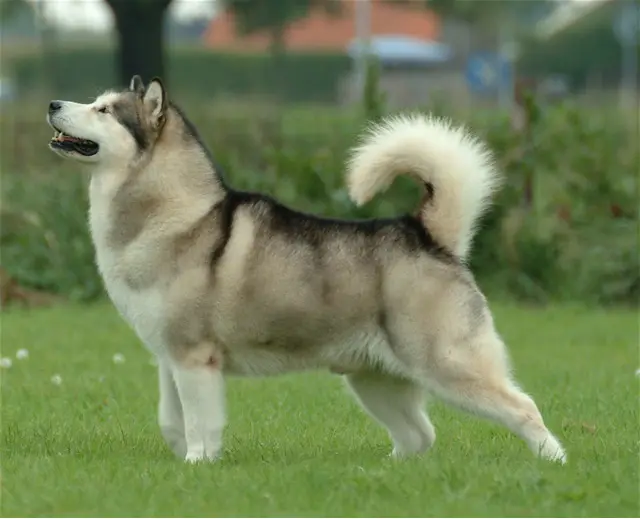
The Alaskan Malamute is a large spitz-type dog originally bred to haul heavy freight by sled, thought to have been developed by the Malimiut Inupiaq people of Alaska's Norton Sound region. It is heavier and more powerfully built than the Siberian Husky, with a dense double coat, erect ears and a plumed tail carried over the back.
Breed facts
| Origin | United States |
|---|---|
| Height at the withers | 59–64 cm |
| Weight | 34–38 kg |
| Life expectancy | 10–12 years |
| Size group | Large |
| FCI | — (Wikidata lists no FCI standard number) |
| Breed standards | — |
From Wikidata (CC0) and the FCI breed list; — means Wikidata lists no figure.
Origin and history
The Malamute is considered a basal breed that predates modern breeds of the nineteenth century, and genetic studies link it to Chukotka sled dogs from Siberia. It worked alongside people in the Arctic, hunting large animals such as bears, locating seal breathing holes and pulling heavy loads to villages and camps. Malamutes were in demand during the Klondike Gold Rush, accompanied Richard Byrd's expedition to the South Pole and served in World War II, mainly in search and rescue. In 2010 it became the official state dog of Alaska.
Appearance and coat
The AKC standard gives a desired size of 58 cm and 34 kg for females and 64 cm and 39 kg for males, though heavier and lighter dogs are common. The double coat has an oily, woolly undercoat up to two inches thick and a coarse outer coat. Colors range from grey, sable, black, seal or red with white to solid white. Eyes are almond-shaped and brown; blue eyes are highly undesirable.
Temperament
The source text says little about temperament beyond describing the Malamute as a heavy dog of more formidable nature than the Siberian Husky, bred for power rather than speed. Breed club descriptions are the best guide to the character of individual dogs.
Care and exercise
Sources give little detail on daily care. As a working breed developed for heavy hauling in cold climates, it is generally described as needing regular, substantial activity, and its thick double coat is adapted for snow and harsh weather.
Health
Conditions reported in the breed include hip and elbow dysplasia, hereditary cataracts, progressive retinal atrophy, inherited polyneuropathy, osteochondrodysplasia, hypothyroidism, diabetes and zinc deficiency, which can affect the skin and coat. A 2024 UK study found an average life expectancy of 11.3 years.
General information, not veterinary advice.
FAQ
How big does an Alaskan Malamute get?
Malamutes typically stand about 59–64 cm and weigh about 34–38 kg, though some individuals weigh 45 kg or more.
What is the difference between a Malamute and a Siberian Husky?
The Malamute is larger and heavier, bred for hauling heavy freight, while the Siberian Husky is smaller and bred for speed.
How long do Alaskan Malamutes live?
A commonly cited range is 10–12 years, and a 2024 UK study found an average of 11.3 years.