Dog breed · FCI 5
Basenji
In short
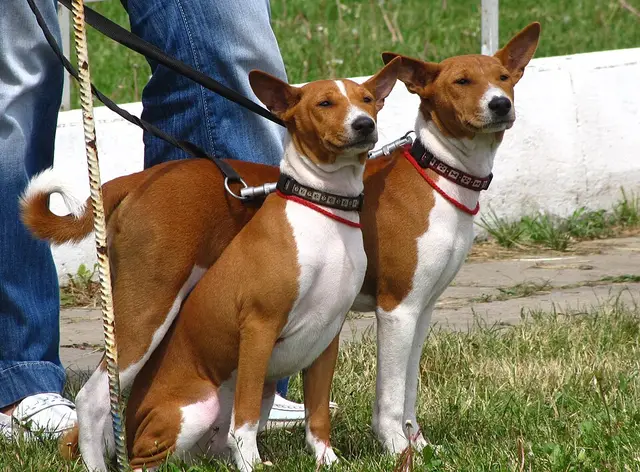
The Basenji is a small hunting dog bred from stock originating in Central Africa, including the Congo region. Standing about 40–43 cm and weighing 9.5–11 kg, it is famous for not barking in the usual way, instead making a yodel-like sound.
Breed facts
| Origin | Congo - Kinshasa |
|---|---|
| Height at the withers | 40–43 cm |
| Weight | 9.5–11 kg |
| Life expectancy | — |
| Size group | Medium |
| FCI | Group 5: Spitz and primitive types · standard no. 43 |
| Breed standards | FCI |
From Wikidata (CC0) and the FCI breed list; — means Wikidata lists no figure.
Origin and history
Genome studies identify the Basenji as a basal breed that predates modern breeds; like the dingo, it carries only two copies of the starch-digesting AMY2B gene. It has been linked with curled-tail, erect-eared dogs in Egyptian murals some 4,500 years old.
A Basenji-like dog appears in an 1843 painting owned by Queen Victoria. Early imports to England died of disease, and foundation stock was only established in England and the United States in the 1930s. The AKC accepted the breed in 1943 and later reopened its stud book to new imports from Africa.
Appearance and coat
The Basenji is small and short-haired, with erect ears, a tightly curled tail, an arched neck, almond-shaped eyes and a forehead that wrinkles, especially when young or excited. Average height is 40 cm for females and 43 cm for males, with weights of 9.5 and 11 kg. Accepted colors include red and white, black and white, tricolor, and brindle and white.
Temperament
An unusually shaped larynx gives the breed its yodel-like talking voice. One local name refers to its habit of jumping straight up to spot quarry. In Stanley Coren's The Intelligence of Dogs it was ranked the second least trainable breed for obeying commands, a trait commonly linked to its independent, primitive nature.
Care and exercise
The FCI standard calls for a swift, long, tireless stride, reflecting a hunting dog bred to cover ground. Sources give little specific care guidance; the short coat is generally regarded as easy to keep.
Health
A 2004 UK Kennel Club survey found a median lifespan of 13.6 years. Conditions reported in the breed include Fanconi syndrome, which is unusually common in Basenjis, inherited haemolytic anaemia, dermatitis, incontinence and bladder infection, and hypothyroidism. A DNA test is available for haemolytic anaemia.
General information, not veterinary advice.
FAQ
Do Basenjis bark?
Not in the usual way. Because of an unusually shaped larynx they make a yodel-like sound, which earns them the nickname barkless dog.
How big does a Basenji get?
Average height is about 40 cm for females and 43 cm for males, with weights of about 9.5 and 11 kg.
How long do Basenjis live?
A 2004 UK Kennel Club survey found a median lifespan of 13.6 years, with the oldest dog in the survey reaching 17.5.