Dog breed · FCI 5
Xoloitzcuintle
In short
The Xoloitzcuintle, or Xolo, is a hairless dog breed from Mexico whose name comes from the Aztec god Xolotl and the Nahuatl word for dog. It comes in standard, miniature and toy sizes and in hairless and coated varieties, and is described as calm and attentive.
Breed facts
| Origin | Mexico |
|---|---|
| Height at the withers | 25–62 cm |
| Weight | — |
| Life expectancy | — |
| Size group | Large |
| FCI | Group 5: Spitz and primitive types · standard no. 234 |
| Breed standards | FCI |
From Wikidata (CC0) and the FCI breed list; — means Wikidata lists no figure.
Origin and history
Ceramic figures of hairless dogs have been found in ancient West Mexican burial sites, and dogs resembling Xolos were buried with their owners as guides to the underworld. The breed nearly disappeared, and in 1954 an FCI-sanctioned expedition led by Norman Pelham Wright found ten sound dogs that became the foundation of Mexico's revival program. The Xolo was officially recognized on May 1, 1956, and returned to the AKC show ring in 2011. Mexico City named it a cultural heritage and symbol of the city in 2016.
Appearance and coat
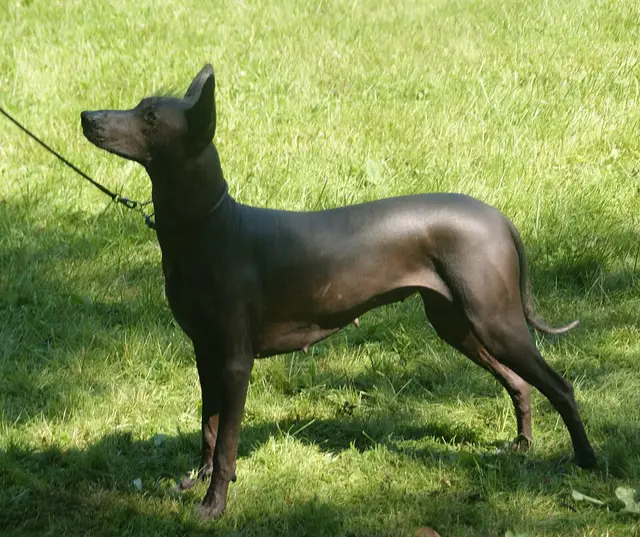
Xolos range from about 5 to 23 kg and 23 to 67 cm, with a sleek, slightly rectangular body, almond-shaped eyes, large bat-like ears and a long neck. Hairlessness is a dominant trait caused by a FOXI3 gene mutation, and most litters contain both hairless and coated puppies. Hairless dogs may have a few hairs on the head, toes and tail and usually have incomplete teeth. Common colors include black, grey, bronze, blonde, blue and red.
Temperament
The breed is described as having a calm and attentive temperament. Sources give little further detail, so breed club descriptions are the best guide to individual dogs.
Care and exercise
Originating in tropical regions, the breed is considered unsuited to living outdoors in colder climates and is best kept indoors. Regular bathing, light grooming and basic skin care are recommended, since neglect can cause acne or other skin problems, while excessive bathing can strip the skin's natural oils.
Health
Sources give little detail on inherited conditions. Skin problems are the most frequently mentioned concern, often linked to poor breeding or improper skin care, and hairless dogs typically have missing teeth. Breed clubs recommend health screening of breeding stock and regular veterinary check-ups.
General information, not veterinary advice.
FAQ
How big does a Xoloitzcuintle get?
It depends on the size variety: Xolos range from about 23 to 67 cm and roughly 5 to 23 kg across toy, miniature and standard sizes.
Are all Xolos hairless?
No. Both hairless and coated puppies are usually born in the same litter; the coated form has a short, flat, dense coat.
Is the Xoloitzcuintle recognised by the FCI?
Yes. The FCI lists it as breed number 234 in Group 5, spitz and primitive types.