Dog breed · FCI 5
Karelian Bear Dog
In short
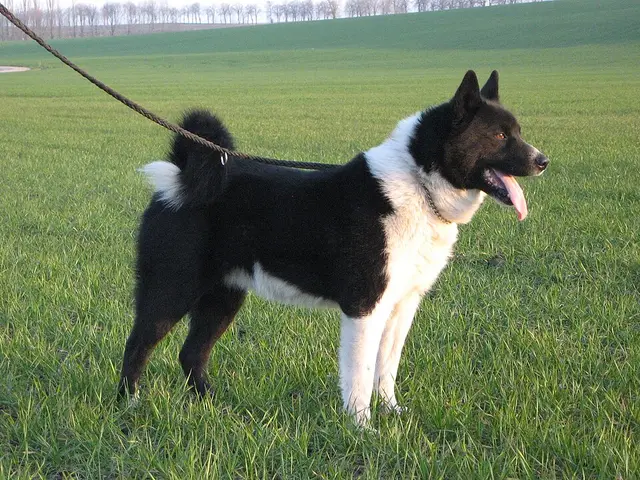
The Karelian Bear Dog is a Finnish hunting breed seen by many in Finland as a national treasure. It was bred to find and bark at big game, including brown bears, moose and wild boar. It is a medium-sized, black-and-white spitz standing about 49 to 60 cm.
Breed facts
| Origin | Finland |
|---|---|
| Height at the withers | 49–60 cm |
| Weight | 17–28 kg |
| Life expectancy | — |
| Size group | Large |
| FCI | Group 5: Spitz and primitive types · standard no. 48 |
| Breed standards | FCI |
From Wikidata (CC0) and the FCI breed list; — means Wikidata lists no figure.
Origin and history
The breed descends from the Komi dog, with foundation stock from Ladoga, Olonets and East Karelia. Breeding began in 1936 to create a sturdy dog that would bark at big game; the first standard followed in 1945. It was used on small fur-bearing animals as well as moose, lynx, wolf and brown bear. It has since been used to reduce human-bear conflicts in the US, Canada and Japan; in Karuizawa, Japan, black bear incidents fell from 255 in 2006 to four in 2017.
Appearance and coat
Males stand 54 to 60 cm and weigh 25 to 28 kg; females stand 49 to 55 cm and weigh 17 to 20 kg. The coat has straight, stiff guard hairs over a fine, soft, thick undercoat. Today's standard calls for black-and-white markings, though early dogs also came in wolf grey, red and black-and-tan.
Temperament
The breed is described as very affectionate with its owners and not aggressive towards people, though it may be reserved if poorly socialized. It is usually described as aggressive towards other animals and can be territorial with other male dogs. Its social nature can make it prone to separation anxiety.
Care and exercise
Sources describe a working breed that prefers the outdoors, needs plenty of space to run and a lot of mental and physical stimulation. Early socialization is advised, and these needs are said to keep it from being a popular companion dog.
Health
Conditions reported in the breed include an inherited chondrodysplasia, caused by a recessive mutation in the ITGA10 gene, and pituitary dwarfism linked to an LHX3 mutation inherited from German Shepherd ancestry.
General information, not veterinary advice.
FAQ
Is the Karelian Bear Dog good with other pets?
It is usually described as aggressive towards other animals, so socialization with other house animals is advised.
How big does a Karelian Bear Dog get?
Males stand 54 to 60 cm and weigh 25 to 28 kg; females are 49 to 55 cm and 17 to 20 kg.
Is the Karelian Bear Dog recognised by the FCI?
Yes. It is FCI breed number 48 in Group 5, Spitz and Primitive Types.