Dog breed · FCI 9
Cavalier King Charles Spaniel
In short
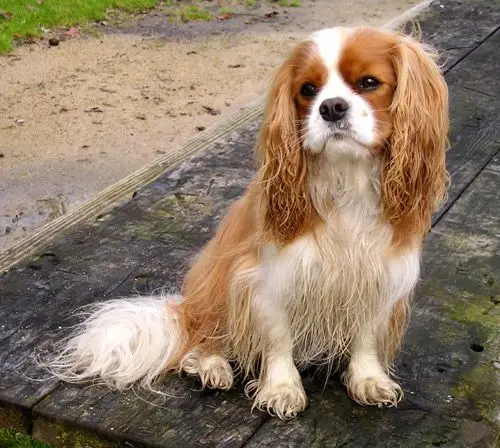
The Cavalier King Charles Spaniel is a British toy spaniel, recreated in the 1920s to resemble the spaniels of King Charles II's era. It is small for a spaniel, with a silky, feathered coat in four colours, and is described as playful, patient and eager to please.
Breed facts
| Origin | United Kingdom |
|---|---|
| Height at the withers | 30–33 cm |
| Weight | 5.4–8 kg |
| Life expectancy | — |
| Size group | Small |
| FCI | Group 9: Companion and Toy dogs · standard no. 136 |
| Breed standards | FCI, The Kennel Club (UK) |
From Wikidata (CC0) and the FCI breed list; — means Wikidata lists no figure.
Origin and history
Its predecessors were toy spaniels that were crossed with flat-nosed breeds in the nineteenth century. In 1926 the American Roswell Eldridge offered prizes for Blenheim spaniels of the old, longer-faced type, which led to the first Cavalier club in 1928. The Second World War nearly destroyed the breeding stock, and the Kennel Club recognised the breed in its own right in 1944. The American Kennel Club followed in 1995.
Appearance and coat
Cavaliers are larger than the closely related King Charles Spaniel, with a flat skull, higher-set ears and a longer muzzle. The coat is silky, of moderate length and free from curl, with feathering on the ears, legs, feet and tail. Recognised colours are Blenheim (chestnut and white), tricolour, black and tan, and ruby.
Temperament
The breed is commonly described as playful, patient and eager to please, and most are said to be good with children and other dogs. Cavaliers tend to treat strangers as friends, so they rarely make guard dogs, and they may chase moving objects and small animals. Their calm disposition makes them frequent therapy dogs.
Care and exercise
The coat needs weekly brushing but no trimming, though some owners trim the feathering on the feet. Cavaliers are described as active and sporting and take part in obedience and agility.
Health
Conditions reported in the breed include mitral valve disease, the leading cause of death in the breed, syringomyelia, episodic falling, hip dysplasia, luxating patella, dry eye, hereditary cataracts and other eye disorders, and glue ear (primary secretory otitis media). The breed descends from a small number of dogs, which is linked to these inherited problems. In 2022 a Norwegian court banned breeding Cavaliers in Norway on welfare grounds. Life expectancy is usually given as eight to twelve years.
General information, not veterinary advice.
FAQ
How big does a Cavalier King Charles Spaniel get?
Cavaliers are small, typically about 30–33 cm tall and about 5.4–8 kg.
How long do Cavalier King Charles Spaniels live?
The lifespan is usually between eight and twelve years; a 2024 UK study found 11.8 years.
What is the difference between a Cavalier and a King Charles Spaniel?
The Cavalier is larger, with a flat skull, higher-set ears and a longer muzzle, while the King Charles Spaniel is smaller with a domed skull.
Is the Cavalier King Charles Spaniel recognised by the FCI?
Yes. The FCI lists it as breed number 136 in Group 9, companion and toy dogs.