Dog breed · FCI 9
Pug
In short
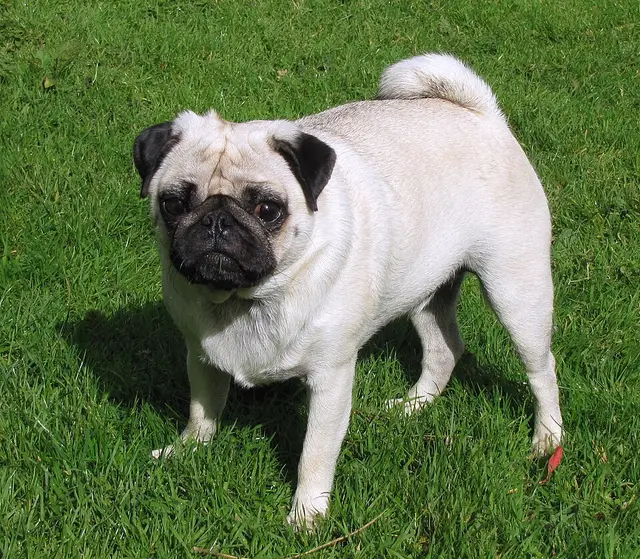
The Pug is a small companion dog of Chinese origin, brought to Europe in the sixteenth century and popularized by the House of Orange and later Queen Victoria. It has a compact, square, muscular body, a wrinkled short-muzzled face and a curled tail, and is widely described as sociable and gentle.
Breed facts
| Origin | China |
|---|---|
| Height at the withers | 30 cm |
| Weight | 6.3–8.1 kg |
| Life expectancy | 14 years |
| Size group | Small |
| FCI | Group 9: Companion and Toy dogs · standard no. 253 |
| Breed standards | FCI |
From Wikidata (CC0) and the FCI breed list; — means Wikidata lists no figure.
Origin and history
The Pug's ancestor was the Lo-Chiang-Sze, a short-coated dog popular at the imperial court during the Song dynasty and bred as a companion for ruling families. The Dutch East India Company brought it to Europe, where it reportedly became the official dog of the House of Orange. Queen Victoria bred Pugs herself, and dogs taken from the Old Summer Palace in Beijing after 1860 likely shaped the modern shorter-legged type. The American Kennel Club recognized the breed in 1885.
Appearance and coat
Modern standards favor a square, cobby body with a deep chest and well-developed muscle. The muzzle is blunt and very short, the tail curls tightly over the hip, and the ears are either rose or the preferred button shape. The smooth, glossy coat is fawn, apricot fawn, silver fawn or black, often with a black line from the back of the head to the tail.
Temperament
The American Kennel Club describes the Pug as even-tempered and charming, and its motto is multum in parvo, much in little. Pugs are commonly described as playful, sensitive to their owners' moods and eager to please, and are often called shadows because they like to follow their people around.
Care and exercise
Sources give little detail on exercise, but UK research found Pugs about three times more likely than other breeds to become obese, so weight is a commonly noted concern. The short face makes it hard for the dog to cool itself, and some airlines restrict carrying them in cargo.
Health
Conditions reported in the breed include brachycephalic obstructive airway syndrome, eye injuries such as proptosis and corneal damage, dry eye, obesity, hip dysplasia, demodicosis, hemivertebrae and necrotizing meningoencephalitis (Pug Dog Encephalitis). Pugs often need cesarean births. Life expectancy figures vary; one UK study found 11.6 years.
General information, not veterinary advice.
FAQ
How big does a Pug get?
Pugs are small dogs, commonly listed at about 30 cm tall and 6.3–8.1 kg.
How long do Pugs live?
A commonly cited figure is about 14 years, but studies vary: one UK study found 11.6 years and a Japanese study 12.8 years.
Are Pugs good family dogs?
Pugs were bred purely as companions and are commonly described as sociable, playful and gentle, thriving on human company.
Is the Pug recognised by the FCI?
Yes. The FCI lists the Pug as breed number 253 in Group 9, companion and toy dogs.