Dog breed · FCI 9
Pekingese
In short
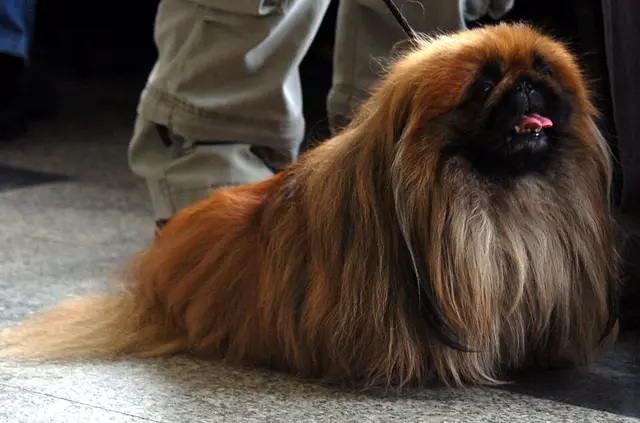
The Pekingese is a toy dog from China, favored as a companion by the Chinese imperial court and named after Peking (Beijing). It is compact and low, weighs around 5 kg, and is known for its flat face, large eyes, long double coat and rolling gait.
Breed facts
| Origin | China |
|---|---|
| Height at the withers | — |
| Weight | 5–5.4 kg |
| Life expectancy | — |
| Size group | Small |
| FCI | Group 9: Companion and Toy dogs · standard no. 207 |
| Breed standards | FCI |
From Wikidata (CC0) and the FCI breed list; — means Wikidata lists no figure.
Origin and history
The breed emerged from small dogs kept by Chinese aristocratic families and could only be owned by members of the Imperial Palace. During the Second Opium War in 1860 the Old Summer Palace was sacked, and a British officer brought a Pekingese to England and presented it to Queen Victoria, who named it Looty.
Empress Dowager Cixi later gave Pekingese to several Americans, and around 1900 the breed became fashionable in the West. Its popularity has since declined, partly because of the work its coat requires, but it has won Best in Show at Westminster five times. Chinese legend says it descends from a lion and a marmoset, or a lion and a butterfly.
Appearance and coat
The Pekingese has a flat face, large eyes and a compact, muscular body low to the ground, slightly longer than tall. Bowed front legs and a pear-shaped body give it a rolling gait. It stands about 15–23 cm; the AKC disqualifies dogs over 14 lb (6.4 kg). Most are gold, red or sable, though cream, black, white and tan occur; the exposed skin of the muzzle, lips and eye rims is black. A smaller sleeve Pekingese also exists.
Temperament
Sources say little about temperament. The breed was developed purely as a palace companion, and the butterfly-lion legend describes it as brave as a lion yet dainty as a butterfly.
Care and exercise
The Pekingese is considered high-maintenance to groom: both layers of its heavily shedding double coat need brushing, it should not be shaved, and the facial creases and eyes need daily cleaning. Exercise needs are minimal; because of its short snout it is prone to overheating and breathing difficulty, so walks are kept short and cool, with plenty of water.
Health
A 2024 UK study found a life expectancy of 13.3 years. As a brachycephalic breed, conditions reported include breathing problems such as brachycephalic obstructive airway syndrome, trichiasis, eye ulcers and injuries, keratitis, dry eye, progressive retinal atrophy, heatstroke and neurological and cardiovascular defects. The UK Kennel Club changed its standard in 2008 to require an evident muzzle.
General information, not veterinary advice.
FAQ
How big does a Pekingese get?
It is a toy breed standing about 15–23 cm and weighing around 5 kg; the AKC disqualifies dogs over 14 lb (6.4 kg).
Do Pekingese shed?
Yes. The double coat sheds heavily and needs frequent, thorough grooming to prevent mats.
How long do Pekingese live?
A 2024 UK study found a life expectancy of 13.3 years for the breed.