Dog breed · FCI 9
Chihuahua
In short
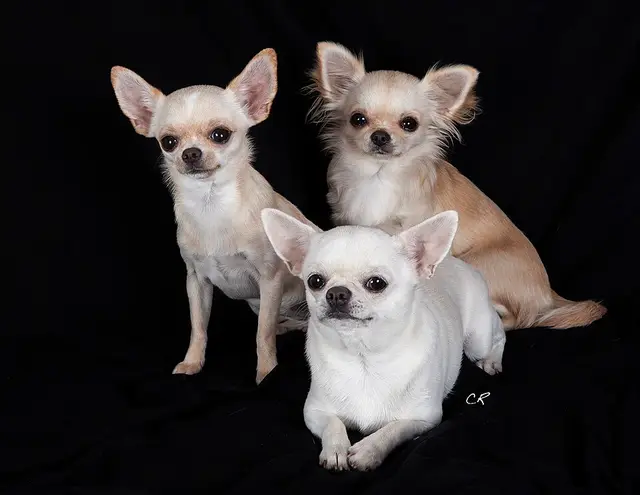
The Chihuahua, or Chihuahueño, is a Mexican toy breed and the smallest recognized dog breed in the world. The FCI standard calls for an ideal weight of 1.5 to 2.5 kg, and dogs outside 1 to 3 kg are disqualified from shows. It is kept mainly as a companion and comes in short-coated and long-coated varieties.
Breed facts
| Origin | Mexico |
|---|---|
| Height at the withers | — |
| Weight | 1–3 kg |
| Life expectancy | — |
| Size group | Small |
| FCI | Group 9: Companion and Toy dogs · standard no. 218 |
| Breed standards | FCI |
From Wikidata (CC0) and the FCI breed list; — means Wikidata lists no figure.
Origin and history
Genetic studies indicate that the Chihuahua retains a small share of pre-Columbian indigenous American dog ancestry; a 2020 study of ancient genomes estimated about 4%, unusual among modern breeds, which are largely of European origin.
Colonial records describe small, nearly hairless dogs in the early 19th century, and one account claims 16th-century conquistadores found them plentiful in the region later called Chihuahua. The American Kennel Club registered its first Chihuahua, Midget, owned by H. Raynor of Texas, in 1904.
Appearance and coat
Breed standards specify an apple-shaped skull with large round eyes, large erect ears and a well-defined stop. Many Chihuahuas have a molera, a soft spot on the skull similar to an infant's fontanel. Height is not usually specified, but is generally 15 to 23 cm. The coat may be short or long and appears in almost any color or pattern, though the FCI standard disallows merle. Pet Chihuahuas often weigh more than the show standard.
Temperament
Like many small dogs, the Chihuahua may show above-average aggression toward people and other dogs, and the American Kennel Club does not recommend the breed for families with young children. It is described as getting along reasonably well with other dogs, depending on the other dog.
Care and exercise
Sources give little detail on exercise needs. Because of its tiny size, care around handling and keeping a healthy weight is generally advised, and puppies of toy breeds are noted to be susceptible to low blood sugar, often linked to getting cold. Regular veterinary check-ups are commonly recommended.
Health
Conditions reported in the breed include atlantoaxial instability, congenital hydrocephalus, congenital deafness, necrotizing meningoencephalitis, other neurological diseases and medial patellar luxation; difficult birth is also much more common than average. Life expectancy figures vary widely by study, from 7.9 years in a 2022 UK study to 11.8 years in a 2024 UK study.
General information, not veterinary advice.
FAQ
How big does a Chihuahua get?
The FCI standard calls for 1.5 to 2.5 kg, and height is generally 15 to 23 cm. Pet Chihuahuas often weigh more than the show standard.
How long do Chihuahuas live?
Studies vary: a 2024 UK study and a Japanese cemetery study both found about 11.8 years, while other studies reported lower figures.
Are Chihuahuas good with children?
The American Kennel Club does not recommend Chihuahuas for families with young children, and the breed may show above-average aggression like many small dogs.
What is a molera on a Chihuahua?
The molera is a soft spot on the top of the skull, similar to the fontanel in human babies. It can be hard to see but is easy to feel.