Dog breed · FCI 9
King Charles Spaniel
In short
The King Charles Spaniel, also called the English Toy Spaniel, is a small toy spaniel from Great Britain, long associated with English royalty and King Charles II. It weighs about 3.6 to 6.3 kg and is commonly described as a quiet, friendly lapdog.
Breed facts
| Origin | United Kingdom |
|---|---|
| Height at the withers | — |
| Weight | 3.6–6.3 kg |
| Life expectancy | — |
| Size group | Small |
| FCI | Group 9: Companion and Toy dogs · standard no. 128 |
| Breed standards | FCI, The Kennel Club (UK) |
From Wikidata (CC0) and the FCI breed list; — means Wikidata lists no figure.
Origin and history
Early toy spaniels, thought to have come from East Asia, appeared in Europe in the 16th century and became linked with English royalty from the reign of Queen Mary I. The breed takes its name from King Charles II, who kept many small dogs. In the early 19th century these spaniels were likely crossed with East Asian breeds such as the Japanese Chin, Pekingese and Pug to shorten the nose.
In 1903 The Kennel Club combined four toy spaniel breeds, the King Charles, Blenheim, Ruby and Prince Charles, under one name. Later attempts to recreate the older type produced the Cavalier King Charles Spaniel, which is larger with a flat head and longer nose.
Appearance and coat
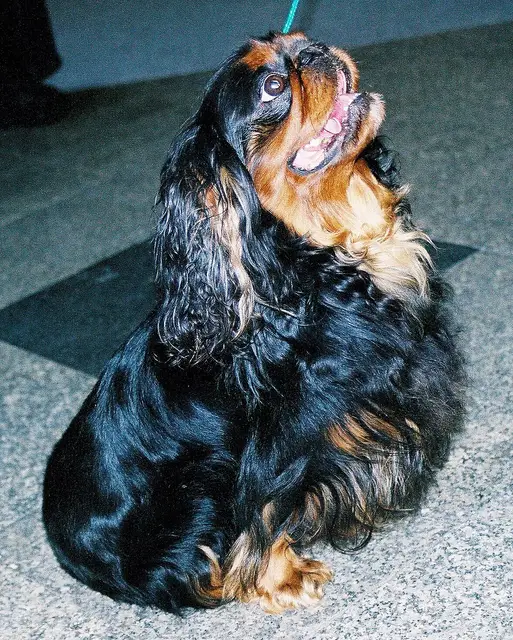
The King Charles has large dark eyes, a short nose, a high domed head and long pendulous ears, and stands on average about 23 to 28 cm at the withers. Four colour patterns reflect the merged breeds: black and tan (King Charles), tricolour (Prince Charles), red and white with a red spot on the skull (Blenheim) and solid rich red (Ruby).
Temperament
The breed is commonly described as friendly, low-energy and devoted to family, and as one of the quietest toy breeds, suited to apartment living. It bonds well with children but will not accept rough handling, and prefers not to be left alone for long. It can retain hunting instincts toward small animals, and its stable temperament has made it a successful therapy dog.
Care and exercise
As a low-energy lapdog, the breed has modest exercise needs. Its narrow, brachycephalic airways can limit exercise and increase susceptibility to heat stroke, so owners are generally advised to take care in hot weather.
Health
The average lifespan is given as 10 to 12 years. Conditions reported in the breed include mitral valve disease, patent ductus arteriosus, cataracts, corneal dystrophy, distichia, entropion, patellar luxation, diabetes mellitus, cleft palate, umbilical hernia, hanging tongue and open fontanelle, sometimes with hydrocephalus. As a brachycephalic breed it can be sensitive to anaesthesia. Health research on the breed is limited.
General information, not veterinary advice.
FAQ
What is the difference between a King Charles Spaniel and a Cavalier?
The King Charles is smaller, about 3.6 to 6.3 kg, with a domed head and a flat face, while the Cavalier is larger with a flat skull, higher-set ears and a longer muzzle.
How long do King Charles Spaniels live?
The average lifespan is reported as about 10 to 12 years.
Are King Charles Spaniels good with children?
They are commonly described as bonding well with and tolerating children, but they do not accept rough handling.