Folklore · Latin America · Legend
El Silbón (The Whistler)
Also known as: The Whistler, El Silbador, Silbón, Finfín, Sinfín, El Silbón de los Llanos
In short
El Silbón is a ghost of the Llanos, the tropical grasslands of Venezuela and eastern Colombia. He is said to be the soul of a young man who killed his father and was cursed to wander forever with the bones in a sack, whistling. In the plains it is said that if his whistle sounds near he is far away, and if it sounds far away he is close.
At a glance
| Where | The Llanos of Venezuela, above all Portuguesa state, and the Eastern Llanos of Colombia |
|---|---|
| Earliest record | Oral tradition; usually said to have arisen around Guanarito, Portuguesa, in the mid-19th century |
| Best-known version | A spoiled son kills his father over a deer and is cursed by his grandfather to carry the bones |
| Type | Ghost, lost soul (alma en pena), cautionary figure |
| Signs | A whistle that climbs the notes do, re, mi, fa, sol, la, si, and bones rattling in a sack |
| Who he hunts | Drunkards and womanizers, in most accounts |
The Venezuelan story Contains the ending
The young man was spoiled by his parents, spent his time drinking in cantinas, and was known for his whistling. One day he told his mother he wanted deer offal (asaduras) for dinner. His father went hunting and came back with nothing.
Drunk and angry, the son beat his father and killed him, then cut out his entrails with a knife and brought them home to be cooked. His mother, or in Colombian tellings his grandmother, saw what they were and cried for help.
His grandfather had him tied up and whipped. His wounds were washed with liquor and rubbed with chili, lemon or aloe, depending on who tells it. A sack holding his father's bones was put on his back, and two starving dogs were set on him. Then he was cursed to wander for ever. The dogs, called Tureco or the Devil's dogs, still follow at his heels. In other versions the curse comes from the father or the mother.
The whistle and the bag of bones
The rule most people in the plains know is about distance. If you hear the whistle close by, he is far away and there is no danger. If it sounds far off, he is right beside you. The town of San Martín in Meta, Colombia, puts it this way on its website: if you hear the whistles far away, you have no escape.
He is described as very tall, up to six metres in some accounts, thin, in a worn hat, moving through the treetops. He is said to sit at the corner of a house at night and take the bones out of the sack to count them. Accounts differ on what follows. In one, nothing happens if the people inside hear him, and someone in the house is found dead at dawn if no one does. In another, the house is spared unless a drunkard or a womanizer lives there.
He is said to suck the liquor out of drunk men through the navel, and to tear womanizers apart and add their bones to the sack. A dog's bark, a whip or hot chili are said to drive him off.
How other places tell it
- Portuguesa, Venezuela: the home of the legend, especially the municipality of Guanarito. From there it spread to Cojedes and Barinas.
- Eastern Llanos, Colombia: called El Silbador as well. In one version he was a womanizer and partygoer who died alone and whistles to find company. He may appear to riders and ask to be taken up on the horse.
- Colombia, pitch of the whistle: a high whistle announces the death of a woman, a deep one the death of a man, and the person is usually someone the listener knows.
- San Martín, Meta: the grandmother cooks the entrails and pronounces the curse, and the dog Tureco bites his heels.
What he is
In the Llanos the story works as a warning against drink, violence at home and chasing women, and the punishment matches the sin. Mercedes Franco includes him in her Diccionario de fantasmas, misterios y leyendas de Venezuela (2001). Sources do not agree on his age. Most place the first accounts in the mid-19th century, while one quotation from Franco gives the mid-20th century.
In modern culture
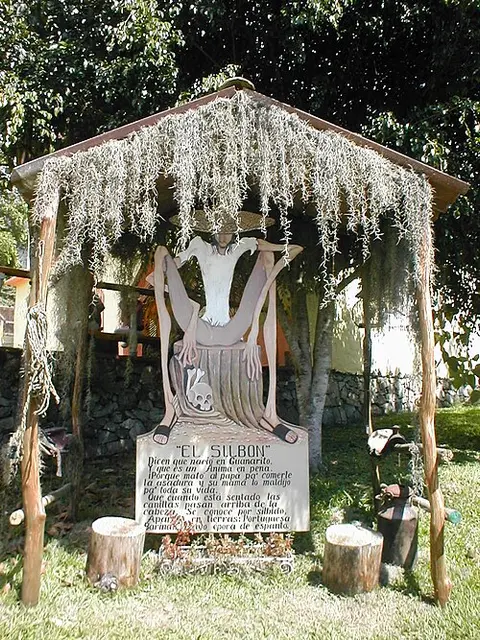
The Venezuelan horror film El Silbón: orígenes (2018), directed by Gisberg Bermúdez, tells an origin story for him alongside a present-day plot. It was released in the United States as The Whistler. An effigy of him stands in the theme park Venezuela de Antier in Mérida state, Venezuela.
Similar legends elsewhere
Same story: the plot is close. Same kind of figure: a similar being in a different story.
- Same kind of figure · Mexico and Latin AmericaLa LloronaAnother lost soul who wanders at night because she killed her own family
- Same kind of figure · VenezuelaLa SayonaA woman's ghost of the same plains who lures and kills unfaithful men
- Same kind of figure · IrelandBansheeA sound heard at night that announces a death in the house
FAQ
Is El Silbón real?
He is a figure of folk belief in the Llanos. Many people there tell of hearing his whistle, and the story is passed on as a true warning, but there is no documented historical case behind it.
What does it mean if the whistle sounds close?
By the traditional rule, a whistle that sounds close means he is far away and you are safe. A whistle that sounds distant means he is near.
What is in El Silbón's sack?
His father's bones. In some versions the sack also holds the bones of his victims.
How do you get rid of El Silbón?
Tradition says he fears dogs, because the dog Tureco chases him, and also whips and hot chili. The best protection, people say, is not to be out drunk on the plains at night.
Sources
- Diccionario de fantasmas, misterios y leyendas de Venezuela, Mercedes Franco, 2001
- El Silbón, Spanish Wikipedia
- El Silbón, English Wikipedia
- Mito o Leyenda: El Silbón, Alcaldía de San Martín, Meta (Colombia)
- El Silbón: orígenes se estrenará en Venezuela el 7 de diciembre, Letralia, 2018
Folktales have many versions. This page follows the best-known version and the earliest written records. Sources checked .