Dog breed · FCI 6
Beagle
In short
The Beagle is a British scent hound that looks like a small foxhound and was bred mainly to hunt rabbit and hare. The modern breed was developed in Great Britain around the 1830s and generally stands 33 to 40 cm at the withers. It is described as merry, gentle and even-tempered, and is widely kept as a companion and used as a detection dog.
Breed facts
| Origin | United Kingdom |
|---|---|
| Height at the withers | 33–40 cm |
| Weight | 9 kg |
| Life expectancy | — |
| Size group | Small |
| FCI | Group 6: Scent hounds and related breeds · standard no. 161 |
| Breed standards | FCI, The Kennel Club (UK) |
From Wikidata (CC0) and the FCI breed list; — means Wikidata lists no figure.
Origin and history
Beagle was used from the Middle Ages as a general name for small hounds, and tiny Glove and Pocket Beagles were kept by English monarchs including Elizabeth I. By the 18th century the Southern Hound and North Country Beagle were used for hare and rabbit hunting.
Reverend Phillip Honeywood's pack in Essex in the 1830s is believed to be the basis of the modern breed, and Thomas Johnson later refined it for looks as well as hunting. The Beagle Club was formed and the first standard written in 1890. Beagles have long been more popular in North America, where the first standard was drawn up in 1887.
Appearance and coat
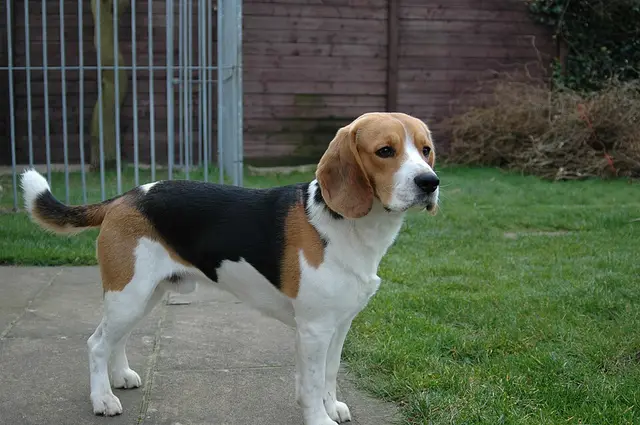
The Beagle resembles a miniature Foxhound but has a broader head, shorter muzzle and shorter legs. It has a domed skull, large hazel or brown eyes, long soft low-set ears and a white-tipped tail, bred so the dog can be seen with its head down. The smooth, hard coat is most often tricolor, with tan and white and other two-color and ticked varieties. The AKC has 13-inch and 15-inch varieties, while the Kennel Club and FCI allow up to about 41 cm.
Temperament
Several breed standards describe the Beagle as merry, and it is commonly described as amiable, gentle and neither aggressive nor timid. It may be reserved with strangers at first but is easily won over, making it a poor guard dog but a good watchdog because it barks or howls. The breed is described as excellent with children and generally good with cats and other dogs, but as a pack animal it can suffer separation anxiety.
Care and exercise
Beagles have great stamina but are described as not too demanding about exercise. Regular exercise helps prevent the weight gain the breed is prone to, as they eat whenever food is available. Their long ears can trap moisture, and when running free they may pick up parasites or grass seeds in eyes, ears and paws.
Health
A 2024 UK study found a life expectancy of 12.5 years. Conditions reported in the breed include epilepsy, hypothyroidism, disc disease, ear infections, glaucoma, corneal dystrophy, cherry eye, Musladin-Lueke syndrome, neonatal cerebellar cortical degeneration and juvenile polyarteritis, also called Beagle pain syndrome. Reverse sneezing is common and not considered harmful.
General information, not veterinary advice.
FAQ
How big does a Beagle get?
Beagles generally stand 33 to 40 cm at the withers, with females slightly smaller on average. The AKC splits them into 13-inch and 15-inch varieties.
Are Beagles good with children?
They are commonly described as excellent with children and get along well with other dogs and cats, which is why they are popular family pets.
How long do Beagles live?
A 2024 UK study found a life expectancy of 12.5 years, close to the average for purebred dogs.
Do Beagles bark a lot?
Most bark when faced with something unfamiliar, and some bay when they catch a scent. Not all Beagles howl.