Dog breed
Bichon Frisé
In short
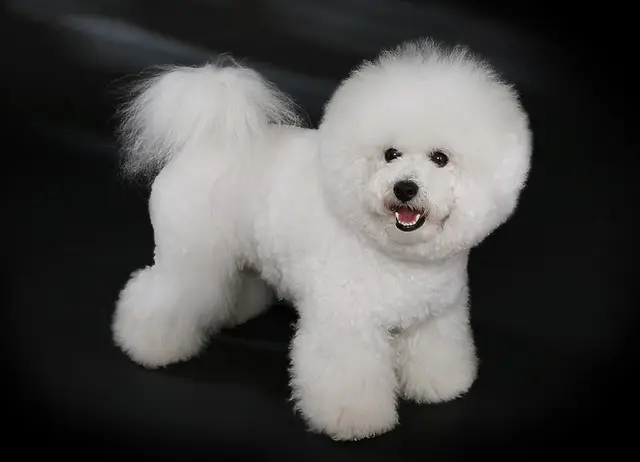
The Bichon Frisé is a small Franco-Belgian toy dog of bichon type, whose name means curly-haired small dog. It stands about 23–30 cm and weighs around 5 kg, with a pure-white coat curled in loose spirals over a soft undercoat. It was recognised by the Société Centrale Canine in 1933 and the FCI in 1959.
Breed facts
| Origin | Canary Islands, Spain, Belgium, and France |
|---|---|
| Height at the withers | 25–29 cm |
| Weight | 5 kg |
| Life expectancy | — |
| Size group | Small |
| FCI | — (Wikidata lists no FCI standard number) |
| Breed standards | — |
From Wikidata (CC0) and the FCI breed list; — means Wikidata lists no figure.
Origin and history
The breed's early history is linked to Spain, and Spanish seamen are generally believed to have introduced the early type to Tenerife in the Canary Islands. From the thirteenth century the dogs entered the royal courts of Spain, Italy and France, and Italian sailors are credited with bringing them back to continental Europe in the fourteenth century. The modern Bichon à Poil Frisé was recognised in France in 1933, reached the United States in 1955 and the United Kingdom in 1973.
Appearance and coat
The skull is rather flat but may appear rounded, and the slightly tapering muzzle makes up two-fifths of the head. The nose is black and the eyes dark and round. The coat is loosely curled in spirals or corkscrews over a thick, soft undercoat and is typically styled into a rounded shape on the head. It is always pure white; dogs under a year old may show a slight beige tinge.
Temperament
The source text gives little detail on temperament. The breed has long been kept as a companion, and breed club descriptions are the best guide to the character of individual dogs.
Care and exercise
Sources give little detail on care. The curly coat with its dense undercoat is typically groomed and styled, and as a small companion breed its exercise needs are generally described as modest; owners should seek specific guidance from breed clubs.
Health
Conditions reported in the breed include immune-mediated hemolytic anemia and gall bladder disease, for both of which studies have found a breed predisposition. Breed clubs recommend health screening of breeding stock and regular veterinary check-ups. A 2024 UK study found a life expectancy of 12.5 years.
General information, not veterinary advice.
FAQ
How big does a Bichon Frisé get?
Bichons are small, standing about 23–30 cm at the withers and weighing around 5 kg.
What colour is a Bichon Frisé?
The coat is always pure white; only puppies under a year may show a slight beige tinge.
How long do Bichon Frisés live?
A 2024 UK study found a life expectancy of 12.5 years for the breed.
Is the Bichon Frisé recognised by the FCI?
Yes. It was definitively accepted by the Fédération Cynologique Internationale in October 1959.