Dog breed · FCI 2
Boxer
In short
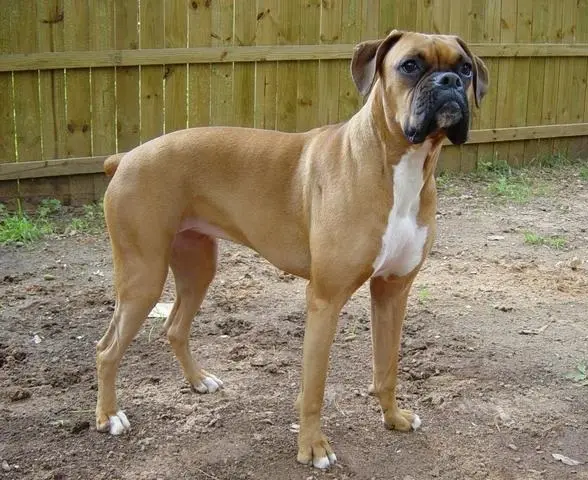
The Boxer is a medium to large, short-haired mastiff-type breed developed in Germany in the late 19th century. It typically stands about 53 to 63 cm tall and weighs around 25 to 30 kg. The breed is commonly described as bright, energetic and playful, loyal to its family but wary of strangers.
Breed facts
| Origin | Germany |
|---|---|
| Height at the withers | 53–63 cm |
| Weight | 25–30 kg |
| Life expectancy | 10 years |
| Size group | Large |
| FCI | Group 2: Pinscher and Schnauzer, Molossoid and Swiss Mountain and Cattledogs · standard no. 144 |
| Breed standards | FCI |
From Wikidata (CC0) and the FCI breed list; — means Wikidata lists no figure.
Origin and history
The Boxer was developed in Germany from the now extinct Bullenbeisser, a hunting dog used to seize and hold bear, boar and deer, and from Bulldogs brought in from Britain. In 1894 Friedrich Robert, Elard König and R. Höpner set out to stabilize the breed; it was exhibited in Munich in 1896, and the Deutscher Boxer Club published the first standard in 1904. Boxers served as messenger, pack and guard dogs in World War I and became popular worldwide after World War II.
Appearance and coat
The head is the Boxer's most distinctive feature: a broad, short skull, a square muzzle about one third of the head's length, and a slight underbite. The short, smooth coat is fawn or brindle, often with white markings called flash. Purebred solid black Boxers do not exist. About 20 to 25 percent of Boxers are born mostly white, and these dogs have a higher risk of deafness and sunburn. Ear cropping and tail docking are banned in some countries.
Temperament
The breed standard describes a dog that is loyal and harmless in the family, distrustful of strangers, friendly at play but brave when aroused. Boxers are often said to be very good and patient with children. They have a slight reputation for being headstrong, and reward-based training is generally reported to work better than corrections.
Care and exercise
Boxers are active, strong dogs that need adequate exercise to prevent boredom behaviors such as chewing or digging. They take part in agility, obedience and flyball, and have worked as service, therapy, guide and police dogs.
Health
Conditions reported in the breed include cancers, notably mast cell tumours, aortic stenosis, Boxer cardiomyopathy, hypothyroidism, hip dysplasia, degenerative myelopathy, epilepsy, bloat and juvenile kidney disease. One UK Kennel Club survey found a median lifespan of 10.25 years, and a 2024 UK study found 11.3 years.
General information, not veterinary advice.
FAQ
How long do Boxers live?
Boxers typically live around 10 years; a 2024 UK study found a life expectancy of 11.3 years and another survey a median of 10.25 years.
Are Boxers good with children?
Boxers are commonly described as patient, spirited and protective with children, which makes them a popular family breed.
Why is it called a Boxer?
The origin of the name is unclear. Popular stories link it to the dog's use of its paws, but several writers favor a derivation from German dialect words for the smaller Bullenbeisser.
Is the Boxer recognized by the FCI?
Yes. The FCI lists the Boxer as breed number 144 in Group 2, and it is in the Working Group of The Kennel Club and the AKC.