Dog breed · FCI 2
Bullmastiff
In short
The Bullmastiff is a large English breed of mastiff type, developed in the 19th century by crossing the English Mastiff with the extinct Old English Bulldog. It typically stands about 61 to 69 cm tall and weighs roughly 41 to 59 kg. It was bred to help gamekeepers guard estates against poachers.
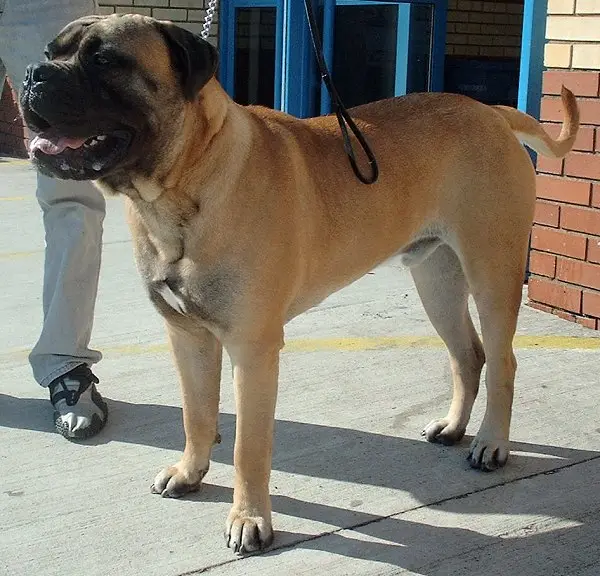
Breed facts
| Origin | United Kingdom |
|---|---|
| Height at the withers | 61–69 cm |
| Weight | 41–59 kg |
| Life expectancy | — |
| Size group | Large |
| FCI | Group 2: Pinscher and Schnauzer, Molossoid and Swiss Mountain and Cattledogs · standard no. 157 |
| Breed standards | FCI, The Kennel Club (UK) |
From Wikidata (CC0) and the FCI breed list; — means Wikidata lists no figure.
Origin and history
The origins of the Bullmastiff are unclear. In some regions of England, Mastiffs and Old English Bulldogs were crossed to produce guard dogs, and by the early 20th century these dogs were widely used by gamekeepers to control poaching, earning the name Gamekeeper's Night Dog. The Kennel Club recognized the breed in 1924, requiring four generations of pure Bullmastiff descent. The AKC followed in 1934 and the FCI definitively accepted it in 1955. In 1928 De Beers imported Bullmastiffs to guard its diamond mines in South Africa.
Appearance and coat
The Bullmastiff is large and solidly built. Females stand about 61 to 66 cm and usually weigh 41 to 50 kg, and males are on average a little taller and heavier. The short coat may be fawn, red or brindle in any shade, with limited white allowed on the chest. The muzzle is black, fading toward the eyes. The breed is brachycephalic and short-muzzled.
Temperament
The available sources say little about temperament. The breed was developed for guarding, combining the strength and speed of the bulldog with the size of the less aggressive Mastiff. Breed clubs and the breed standard are the best guide to its expected character.
Care and exercise
Sources give little detail on care and exercise. As a large, powerful guard breed, it is generally expected to need regular exercise and consistent handling, and owners can ask breed clubs for practical guidance.
Health
Conditions reported in the breed include hip and elbow dysplasia, bloat, entropion, hypothyroidism, ear infections, an inherited form of progressive retinal atrophy, and cancers such as lymphoma and mast cell tumours. One source reports hip dysplasia in 24.5 percent of dogs. A 2024 UK study found a life expectancy of 10.2 years.
General information, not veterinary advice.
FAQ
How big does a Bullmastiff get?
Bullmastiffs typically stand about 61 to 69 cm at the withers and weigh roughly 41 to 59 kg, with males larger than females.
How long do Bullmastiffs live?
A 2024 UK study found a life expectancy of 10.2 years for the breed.
What is the difference between a Bullmastiff and a Mastiff?
The Bullmastiff was created by crossing the Mastiff with the Old English Bulldog, and it is smaller than the English Mastiff.
Is the Bullmastiff recognized by the FCI?
Yes. The FCI definitively accepted it in 1955, and it is breed number 157 in Group 2.