Dog breed
Scottish Terrier
In short
The Scottish Terrier, popularly called the Scottie, is one of five terrier breeds from Scotland, originally bred to hunt vermin, badgers and foxes. It is small and sturdy, standing about 25 to 28 cm tall and weighing roughly 8.5 to 11 kg. It is described as independent, territorial and feisty, but very loyal to its family.
Breed facts
| Origin | United Kingdom |
|---|---|
| Height at the withers | 25–28 cm |
| Weight | 8.5–11 kg |
| Life expectancy | — |
| Size group | Small |
| FCI | — (Wikidata lists no FCI standard number) |
| Breed standards | The Kennel Club (UK) |
From Wikidata (CC0) and the FCI breed list; — means Wikidata lists no figure.
Origin and history
Scotties were once grouped with other Highland terriers under the name Skye Terrier, and the breed is closely related to the West Highland White Terrier. Also called the Aberdeen Terrier, it was standardized from the late 1870s, with a first written standard in 1880. The Scottish Terrier Club of England was founded in 1881, and a revised 1930 standard gave the modern breed its longer head and lower, squarer body. By 1936 Scotties were the third most popular breed in the US, and they have won Best in Show at Westminster nine times.
Appearance and coat
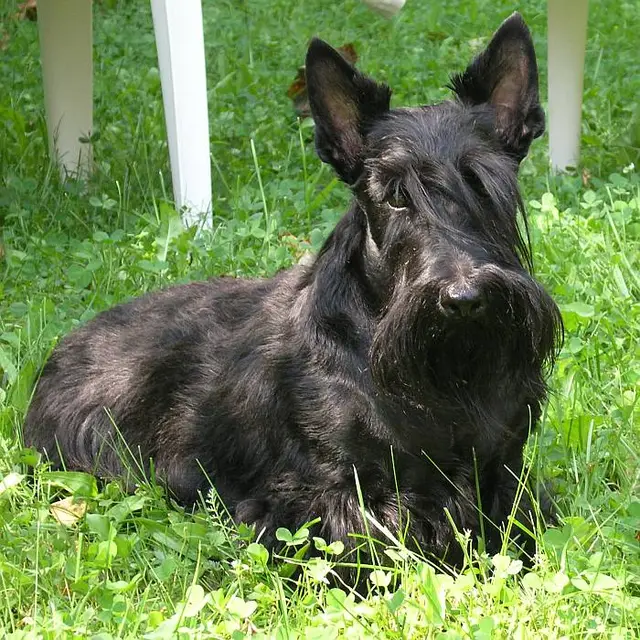
The Scottie is a compact, short-legged, sturdily built terrier with a thick-set body, a keen expression, small almond-shaped eyes, and erect ears and tail. It has a hard, wiry outer coat over a soft, dense undercoat. Colors range from dark gray to jet black and brindle, with wheaten coats occurring sometimes.
Temperament
Scotties are described as territorial, alert and feisty, independent, playful and intelligent, and sometimes stubborn or aloof. They tend to attach strongly to one or two people and are reserved with strangers. They may be aggressive with other dogs unless socialized early, and they tend to dig and chase small mammals. Sources do not recommend them for homes with small children inexperienced with dogs.
Care and exercise
The coat is trimmed to give the distinct Scottie outline, and the longer skirt on the legs and lower body should be brushed daily to prevent mats. Sources give little detail on exercise needs.
Health
Conditions reported in the breed include von Willebrand disease, craniomandibular osteopathy, Scottie cramp, patellar luxation, cerebellar abiotrophy, and several cancers, notably bladder cancer, which research has suggested is about 20 times more likely than in other breeds. A 2024 UK study found a life expectancy of 12.7 years.
General information, not veterinary advice.
FAQ
How big does a Scottish Terrier get?
Scotties typically stand about 25 to 28 cm at the withers and weigh roughly 8.5 to 11 kg.
How long do Scottish Terriers live?
A 2024 UK study found a life expectancy of 12.7 years for the breed.
Are Scottish Terriers good with children?
Properly socialized Scotties can suit a family and act as protectors, but they are not recommended for homes with small children or children inexperienced with dogs.
What is Scottie cramp?
Scottie cramp is an inherited, episodic disorder that affects the dog's ability to walk, usually when it is under stress. It is described as non-painful and not life-threatening.