Dog breed
Shetland Sheepdog
In short
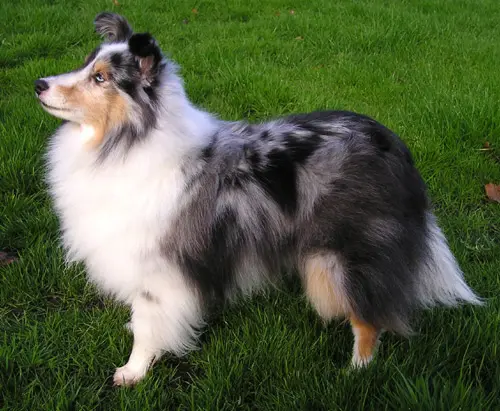
The Shetland Sheepdog, often called the Sheltie, is a small herding breed from the Shetland Islands of Scotland. It stands about 33 to 40 cm tall and resembles a miniature Rough Collie. It is commonly described as clever, vocal, willing to please and trustworthy.
Breed facts
| Origin | United Kingdom |
|---|---|
| Height at the withers | 33–40 cm |
| Weight | — |
| Life expectancy | — |
| Size group | Small |
| FCI | — (Wikidata lists no FCI standard number) |
| Breed standards | — |
From Wikidata (CC0) and the FCI breed list; — means Wikidata lists no figure.
Origin and history
The Sheltie was not created simply by shrinking the Rough Collie. The original sheepdog of Shetland was a small Spitz-type dog, later crossed with collies from mainland Britain, and folk tales also mention a King Charles Spaniel. Rough Collie crosses continued into the 1940s to fix the desired type. The breed was first called the Shetland Collie, but objections from collie breeders led to the name change, and the Kennel Club recognized it in 1909.
Appearance and coat
The Sheltie has a double coat: a long, harsh, straight outer coat over a soft, short undercoat, forming a mane around the neck while the face stays smooth. Colors include sable, tricolor, blue merle, black and white, and black and tan. The breed standard gives an ideal height of about 37 cm for males and 35.5 cm for females. Eyes are dark brown, though merle dogs may have one or both eyes blue.
Temperament
Shelties are commonly described as bright and eager to please. In Stanley Coren's 1995 ranking of working intelligence the breed placed 6th out of 138 breeds.
Care and exercise
Shelties still take part in sheepdog trials, and in their size group they are prominent in agility, obedience, flyball, tracking and herding. Owners generally keep them busy with this kind of activity. The long double coat benefits from regular brushing.
Health
Conditions reported in the breed include allergic skin disease, dermatomyositis, von Willebrand disease, Collie eye anomaly, MDR1 drug sensitivity, bladder cancer and gall bladder mucocele. Hip dysplasia appears comparatively uncommon in one North American study. A UK study found a life expectancy of 13.4 years, and a Japanese study found 14.3 years.
General information, not veterinary advice.
FAQ
Is a Shetland Sheepdog a mini Collie?
It looks like a miniature Rough Collie, but it descends from small Spitz-type island sheepdogs crossed with collies rather than from shrunken Rough Collies.
How long do Shelties live?
One UK study found a life expectancy of 13.4 years, and a Japanese study found 14.3 years.
Do Shelties shed?
Shelties have a long double coat with a soft undercoat, so regular brushing is generally needed to manage loose hair.
Are Shetland Sheepdogs smart?
Stanley Coren ranked the breed 6th out of 138 for working intelligence, and Shelties do well in obedience and agility.