Dog breed · FCI 2
Tibetan Mastiff
In short
The Tibetan Mastiff is a large flock-guarding dog bred in the high Himalayas and on the Tibetan Plateau. It stands roughly 61–66 cm, carries a dense double coat, and is described as intelligent, strong-willed and aloof with strangers.
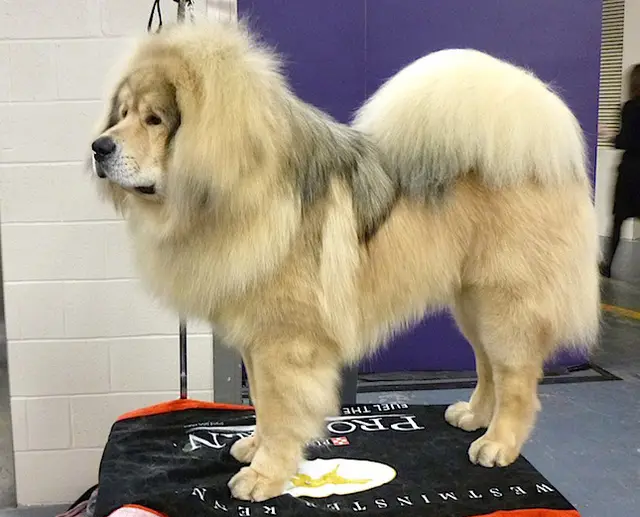
Breed facts
| Origin | China |
|---|---|
| Height at the withers | 61–66 cm |
| Weight | — |
| Life expectancy | — |
| Size group | Large |
| FCI | Group 2: Pinscher and Schnauzer, Molossoid and Swiss Mountain and Cattledogs · standard no. 230 |
| Breed standards | FCI |
From Wikidata (CC0) and the FCI breed list; — means Wikidata lists no figure.
Origin and history
These dogs were used to guard livestock and to protect Tibetan Buddhist monasteries from bears, wolves and snow leopards. Europeans called them mastiffs simply because the word was used for most large dogs. The future George V brought a pair to Britain, and the breed was shown at Crystal Palace by 1906 before nearly dying out in England during the war years.
Interest has grown worldwide since 1980; the breed first competed at Westminster in 2008. A 2020 genomic study found that a gene variant helping it cope with high altitude came from an unknown wolf-like canid.
Appearance and coat
The double coat is medium to long and comes in solid black, black and tan, shades of red from pale gold to deep red, and bluish-grey, often with white markings. The American Kennel Club gives weights of 40–70 kg for males and 30–55 kg for females. The coat sheds dirt and odor, with one heavy molt in late winter or spring. Unusually, the breed keeps a single estrus a year, so most puppies are born in December and January.
Temperament
As a guardian it warns off threats by barking and scent-marking rather than seeking confrontation, and it is known as a night sentry that often sleeps by day. Breed descriptions call it intelligent and stubborn; Western-bred dogs tend to be more easy-going but still aloof with strangers. It is not recommended for novice owners.
Care and exercise
Sources describe the breed as suited to a spacious, fenced yard with a canine companion rather than an apartment. Obedience and socialization training are recommended, though results vary, and owners need to be consistent and plan around the dog's protective instincts.
Health
Breeders often claim 10–16 years, but these claims are unsubstantiated. Conditions reported in the breed include hypothyroidism, entropion, ectropion, distichiasis, allergies, Addison's disease, Cushing's disease, epilepsy, progressive retinal atrophy, cataracts, ear infections, elbow and hip dysplasia, and an inherited neuropathy known as CIDN.
General information, not veterinary advice.
FAQ
How big does a Tibetan Mastiff get?
It stands roughly 61–66 cm; the American Kennel Club gives weights of 40–70 kg for males and 30–55 kg for females.
Do Tibetan Mastiffs shed?
They shed somewhat all year, with one heavy molt in late winter or early spring and sometimes a lighter one in late summer or autumn.
Is a Tibetan Mastiff good for first-time owners?
Sources say it is not recommended for novice owners because it is strong-willed, powerful and protective, and needs consistent training.